Thursday, May 10, 2012

What the budget means for Indigenous health - a personal view


Our family sat down together  to watch the Budget the other night. (“Isn’t there anything else on?” asked one of my daughters. Would the politicians give them fewer nightmares than Doctor Who?) When it got the health parts of the budget, here is what I thought I heard Wayne Swan say: “Hospitals hospitals hospitals hospitals hospitals hospitals....”
I’ve skimmed over quite a bit of the budget coverage, but there isn’t a great deal of commentary on the parts of the budget affecting Aboriginal and Torres Strait Islander health. Croakey has a good summary and there was some good Twitter opinion.
However, I haven’t seen much other analysis more than just listing the components, but I think there are some implications that we need to watch for, so here, for what it’s worth, is my analysis. 

Insert disclaimer- I’m not an economist, just a practitioner enjoying trying to make sense of stuff. My analysis could be very wrong, (I don’t think it is, though!) but it’s a useful starting point for a discussion. This is also my opinion – I do work for some organisations who have official opinions on this, which may or may not coincide with mine!

Overall, the government has increased spending on Indigenous health – up from $1.032 billion to $1.074billion. The headline figure that the government has relating to Indigenous health is $5.2 billion, which is a lovely big sum of money. However, $3.4 billion over 10 years of this is for the Stronger Futures in the Northern Territory.  This also includes $6.4million (it actually says $6.4 but I don’t think that’s what it means!) for preserving AITSISIS collections and the money for SBS to set up a National Indigenous Free to Air TV service. (It’s not clear what happens to NITV). Also included in this sum are a number of projects in local Aboriginal and Torres Strait Islander communities, that all look very good. For people who don’t live in these communities though, there’s not a great deal , and there doesn’t seem to be an overall strategy.

Perhaps an overall strategy is to be found in the “Outcome 8” Indigenous Health documents from the Department of Health and Aging. This lists the budget under the Closing the Gap program around preventing chronic disease. It looks like these haven’t changed much. I don’t see any extra money or new initiatives there, but neither do I see a stripping out of money, which is good, given the context of this budget and the promise for a surplus.

There is also $67.9million dollars being cut from health workforce programs in "streamlining" workforce initiatives, with the money going to other government priorities. Given that the workforce dealing with Aboriginal and Torres Strait Islander health is somewhat understaffed, there could be a problem if there is not the workforce o deliver all these marvellous programs.

There is another pattern to be found in this budget, however. $75 million dollars have been removed from infrastructure projects in indigenous health. This has been redirected towards the Aboriginal and Torres Strait Islander Health program and the Health and Hospitals Fund. Given that  this latter fund includes $48.6million for indigenous health infrastructure in 10 remote communities, this looks like a funding cut to me. Apparently, DoHA say the money has been taken from low priority projects, though I don’t imagine they were low priority when the money was applied for or granted!
In a similar vein, money has been removed from indigenous literacy projects and redirected into Stronger Futures in the Northern Territory. While the right noises are made about primary care and education in the Stronger Futures initiatives, there is a significant amount of opposition to Stronger Futures in Aboriginal communities, because, once again, it continues the European tradition of doing to not working with. Stronger Futures started out as the Northern Territory Emergency Response, then became the Intervention, then became Closing the Gap in the NT and is now Stronger Futures. While the government have done more consulting around this, and there is a wide range of opinions in Aboriginal communities (as you would expect in any community) you could not argue that there was broad support for the measure in Aboriginal communities. The problem is that this will undermine the effectiveness of primary care initiatives and education initiatives done as part of this. There is clear evidence that real partnerships with Aboriginal communities are necessary to make progress in this area.

The other potential for a big narrative in this budget is in the measures for a National Disability Insurance Scheme, the Dental arrangements and the Aged Care measures. Aboriginal people have twice the rate of disability as non-indigenous people, and these disabilities occur at a younger age. There are also well recognised problems with oral health, which have knock on effects for diabetes and cardiovascular health. So these measures have great potential to provide support and much needed care for Aboriginal and Torres Strait Islander people. However, don’t forget that Aboriginal people have had much less access to Medicare and to the Pharmaceutical Benefits Program, and it has needed specific measures to address this. I see no reason why the National Disability Insurance Scheme would be any different with thought put to this. We will not Close the Gap if 10 years from now we have a lovely NDIS operating and Aboriginal people are accessing it at half the rate of non-indigenous people. This needs to be thought about at this stage.
So, I think the budget is a mixed bag for Indigenous Health. It’s worth checking out the media releases from some other organisations on their budget reaction, though, because I was surprised to find myself at the more negative end of the spectrum!
I've not seen a release from NACCHO’s yet, though these were tweets during the budget!
So, as the AMA say, “the devil will be in the detail” and it is worth watching this space closely to see that this significant investment gets to where it is needed and is used in the most effective way. I have no doubt that that will involve partnerships with Aboriginal and Torres Strait Islander communities, rather than impositions.
I’m looking forward to the day when I hear a treasurer stand up to present the budget and hear them saying “Primary Care, Primary Care, Primary Care, Primary Care. Oh. And consultation. Real consultation.”

Sunday, April 22, 2012

Why do I work in Aboriginal health?

That's the question I was asked on Twitter the other day. I was (almost) unable to answer in 140 characters, but it did get me thinking. So here's why.

The first place I got off an aeroplane in Australia was in Alice Springs. I was a naive, young junior doctor. ("You sound like an adventurous sort" said the recruiter. "How about the Northern Territory?" How was I to know any different?). Anyway, I had an absolutely wonderful year in Alice, Tennant Creek and Darwin, and met the woman who is now my wife. After going back to the UK and doing GP training, I came back to Oz and worked in Alice for another year. I spent a long time thinking Alice Springs was just normal Australia, and that work as a doctor in Australia just meant you saw Aboriginal patients. So at one point asking why I work in Aboriginal health would have been like asking me why I see patients. Or like asking a firefighter why they go to put out fires. Isn't that just what you do?

A few years later, I found myself in South West Sydney, and I started to realise that my Alice experience wasn't typical, and that actually Aboriginal health was seen as something seperate from normal practice. There were a few of us (and you can find out exactly how many here) drawn to Aboriginal health, but we were a bit... missionary!

So the first part of why is that I hadn't realised there was an alternative!

But the second part of why I work in Aboriginal health is why I stay in Aboriginal health.

Somewhere along the line in my career (and I can't for the life of me remember when) I learnt about the Inverse Care Law. In a classic paper - in 1971 - that's 1971 - Julian Tudor Hart described a law that is as relevant now as it was then: Those who need medical care the most get the least. It works on a global scale - think of the majority world compared to developed countries. It works on a National scale - think of urban centres compared to rural areas in Australia. And it works across a city - think of the Northern beaches of Sydney, compared to the south-west suburbs.

The areas I worked in the UK all experienced this acutely, and the people who trained me all had a strong view that part of doing General Practice well was working to reduce inequalities (respect to Sheffield VTS!). There is a strong culture in General Practice of working to reduce health inequalities. And this sits with other General Practice values such as Patient Centred care - not the buzzword, but actually trying to do it, and being the speciality with expertise based on research evidence of how to do it well.

So it was natural that I would be drawn to working in Aboriginal health, and that, though the context is different, the skills and the role are those of General Practice anywhere in Australia, anywhere in the UK.

This is where my 1 word Twitter answer is sufficient - values. I am in the hugely priveleged position of being paid to do something I love, which is (I hope) useful, and allows some of the most disadvantaged people to "live lives they would choose to live" - through trying to limit the effects of ill health on them, and through empowering them to be able to make decisions about them, their family and their community.

I'm not alone in this. Some interesting research from Canberra shows interviewed doctors working in challenging areas for more than 5 years shows
"All doctors [in this field] were motivated by the belief that helping a disadvantaged population is the `right thing' to do. They were sustained by a deep appreciation and respect for the population they served, an intellectual engagement with the work itself, and the ability to control their own working hours (often by working part-time in the field of interest). In their clinical work, they recognised and celebrated small gains and were not overwhelmed by the larger context of social disadvantage."
 I wasn't interviewed for this study, but I read it and thought "That's me!"

I finish with a reframing of the original question: Why wouldn't you want to work in Aboriginal health?

Friday, March 9, 2012

A small and select group...

This post has been updated several times to include the 2010 Medical Workforce Survey data 2011 Medical Workforce Survey data published January 2013, the 2012 data published 2014, and the 2014 data published 2015 - See below the main post.

If you had, for example, a really pressing health problem, say, that a particular group of people had much worse health outcomes than the rest of the population, and then you decided to take steps to solve this problem, what would you do?
One of the obvious answers might be to provide a health workforce to help solve the problem. And one of the most obvious (and therefore most studied) components of a health workforce is doctors.
We know that Aboriginal and Torres Strait Islander people have much worse outcomes in health than other Australians. If I told you that there were about 22,000 GPs across the country, how many do you think would work primarily in Aboriginal Medical Services?
You might start by thinking that Aboriginal and Torres Strait Islander people make up 2.5% of the Australian population, so perhaps 2.5% of doctors, which would be 550 doctors. You might then add a few, as you’d think that increased numbers of people with diseases like diabetes, renal disease, mental health problems and the like might need an increased number. We could pick a number at random and add, say, 100 GPs taking us up to 650. (To put this in context, there are 1000 training places for doctors to become GPs this year.)
So would you be surprised to hear that there are 333 GPs across the country who say their main place of work is in an Aboriginal Medical Service. That’s not a typo. That’s 333. 92 of these were doctors training to be GPs, who are often on 6 month placements.

At this point in a blog post which contains numbers, it’s customary to quibble about the statistics. I don’t wish to disappoint you, so here goes:
You: Where are these numbers from? Surely they’re just made up like most statistics?
Me: No, they’re from the 2009 medical workforce survey. Every doctor has to be registered with the Medical Board of Australia, and when they renew they get a survey about their work. These figures were tucked away in the latest release. So they’re a little behind the times, but they are the best figures we have.
You: But it’s not an accurate reflection of the actual number of doctors working in Aboriginal health is it? I mean most doctors see Aboriginal patients in their practice don’t they? They wouldn’t be counted in this.
Me: That’s true. This only counts those who say they primarily work in Aboriginal health. It probably doesn’t include private GPs seeing Aboriginal patients in their normal clinic, and it may not include GPs who work part time in an Aboriginal Medical service and part time in another clinic.
You: And this isn’t just about numbers. Don’t they need to be in the right place, too. It’s pretty hard to get doctors to go rural.
Me: You’re right again. The largest number of Aboriginal and Torres Strait Islander people live in New South Wales. There are 76 GPs in NSW and 77 in the NT. The largest population numerically is in West and South West Sydney. But, still, proportionately more Aboriginal people live in remote and rural parts of Australia.
You: And Doctors aren’t the be all and end all of a medical service. There is probably some compensation from the huge numbers of Aboriginal Health workers and nurses working in this area.
Me: You’re right, doctors aren’t the whole story. Though I doubt the numbers are made up for by other health professions – the other workers in AMSs are often doing non-doctor jobs. And I’m not aware of any figures for these other professions, though this may become clearer with national registration of Aboriginal Health Workers.
 
This really is the best information we have. (At least, the best information I know of – if you know of better stats on this, I’d love to hear from you.) And the bottom line is that for the size of the problem, even allowing for the caveats above, the medical workforce is pitifully small for the size of the problem. It leaves a tiny number of doctors with a large and complex workload. And, because Medicare revenue is generated by doctors, it leaves Aboriginal medical services disadvantaged when it comes to generating funding, too.
There are many reasons for this – those are for another post – but in the mean time, what can you do?
If you’re a GP, do take the opportunity to work in Aboriginal health if you get half a chance.
If you’re someone with policy responsibility, think about what needs to be done to close the gap, what workforce is required to do it, and where they need to be to do it.
If you’re neither of these, stay informed, ask questions and advocate. I’ll post more on this later.

Update 
The AIHW released a little more information on this recently: The 2010 medical workforce survey. Not much is different, but there is a slight change in emphasis. Gone is the state by state breakdown , but instead there is a division into clinical and non-clinical (managerial, education, research and public health roles, I would imagine). So, here goes:

There are 310 doctors working clinically in Aboriginal Medical Services in clinical roles. Across the whole country. Another 35 work in non-clinical roles. They work on average just over 36 hours per week (compare over 23,770 in "private practice", over 17,000 of these GPs at an average of 41.23 hours per week). You'll notice that's fewer doctors working fewer hours. (Guilty m'lud).

Yes, let's quibble aboout the figures. But in the end, I suspect that all the quibbling in the world can't hide the fact that we are medically understaffing the services required to close the gap.

Don't go away too gloomy, though. Aboriginal Medical Service do need more doctors, especially in rural areas, but there is evidence that they do extraordinarily successful work without enough!

Update 2013
Well, look! The results of the 2011 Medical Workforce Survey have just been released  and there are now 532 doctors practicing in an Aboriginal Medical Service setting, 483 of these clinically. Compare this to over 33,000 GPs, over 33,000 in hospital medicine and over 1500 in "Community Health Care service" setting. The figures for doctors in an Aboriginal Medical Service aren't broken down by hours worked or by state this time (yet?) so this is all we have. Slightly more than previous years, but still a small and select group!

Update 2014
The 2012 Medical Workforce Survey results are now out. The picture is much the same.

There are 546 doctors working in Aboriginal health services. 514 of these work clinically. This table is tucked away at the back of the PDF, with the main narrative saying merely that 0.7% of all doctors work in Aboriginal Health Services. 1.54% of the GP workforce work in Aboriginal Health Services.

It's also interesting to note that the number of hours worked on average is less than other GPs (hello, recruitment strategy!) but also that the AMS medical workforce is 50/50 male female and is younger than the mainstream GP workforce. I see signs of sustainability into the future here.

Finally, a comment from the press release - 35% of the whole medical workforce are GPs and 35% are Specialists. I'd love to hear how that compares to other countries. Given that GPs see 85% of the population each year for 6% of the health budget, and we know that most care happens in the community, I'd be wondering if we need a higher proportion of GPs than that. I'd love to hear what you think.
 
Update 2015
I'm not sure when this happened, but the 2014 Medical Workforce Survey data are out. (Presumably, somewhere in the ether are the 2013 data!).


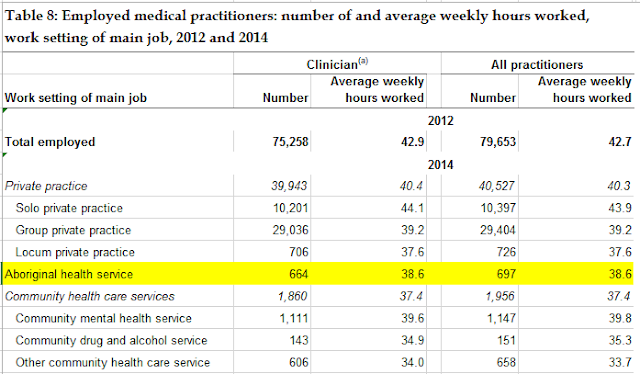
There are now 697 doctors who say their main work setting is in an Aboriginal Health Service, with 664 of these working clinically.

For context, in total there were 40,527 doctors working as GPs and 85,510 doctors in total. so there are 1.7% of GPs or 0.8% of total doctors working in an Aboriginal Health Service setting. That's an increase, though with the average number of hours per week being slightly less, there's slightly more of a workforce shortage than that headcount suggests. (We also know that consultations in an Aboriginal Health Service tend to be longer than in private practice - see here and here - so, again, a simple headcount underestimates the workforce shortage,)

Of course many private GPs and community health services will also see many Aboriginal and Torres Strait Islander patients.

This year's data has little further information about who these doctors are or where in Australia they work.

You can find the data yourself in this Excel spreadsheet and go to Table 8.

So - get recruiting now! We'll see the results come through in the data in a few years time!

Wednesday, March 7, 2012

Trying to be exciting about dull stuff – or a note about terminology!


Words are important. Sticks and stones might break bones, but words can certainly cause quite a bit of harm. So it’s worth just taking a moment to set out some of the thinking behind terminology I’ll be using on the blog, and my thinking behind it. Have you ever read a more boring blog sentence? Well, let’s see if we can make this a fun post. Or failing that, a short one.
The thinking behind what we call Aboriginal and Torres Strait Islander peoples has been heavily influenced by colonisation without us even noticing. Aboriginal is an English word which has come to mean the diverse group of peoples who are the original inhabitants of the land masses we now call mainland Australia and Tasmania. Torres Strait Islanders are the group of people who originally inhabited the islands between the northcoast of Queensland and Papua New Guinea. It’s intriguing that the name we’ve given references a Spanish explorer. I’ll try to write Aboriginal and Torres Strait Islander people when that’s what I mean. Much of the time I’ll write Aboriginal and I’ll mean to include Torres Strait Islanders too, really just for clear English purposes – which I am a bit sorry about, as should English trump the needs of Aboriginal and Torres Strait Islanders once again? I won’t be using the term Aborigine, as I find that dehumanising – it’s all too easy to forget we’re talking about people. And I won’t be using ATSI either, as abbreviations are usually a way of using jargon that allows us to forget the concepts behind the words.
I’ll use indigenous in the context of non-indigenous, meaning people who are not Aboriginal or Torres Strait Islander. I’ll also use indigenous when I want to talk about the indigenous people of other countries, as, for example, in the UN Declaration onthe Rights of Indigenous Peoples.
Other phrases it’s worth being clear on are AMS or Aboriginal Medical Service, which is a primary care service servicing predominantly Aboriginal and Torres Strait Islander people. An Aboriginal Community Controlled Heath Organisation (ACCHO), are essentially owned and run by their local communities. Not all AMSs are ACCHOs – Inala in Queensland is an example – and there are some ACCHOs which are not AMSs, providing social rather than health care. Often, the term Medical Service doesn’t do these organisations justice, as that is only a part of what they do, and they are much more than a doctor’s surgery that happens to see Aboriginal patients.
And, just to put a nice cap on all the confusion, there’s Close the Gap and Closing the Gap. Surely they must be the same thing? I’m afraid not. Closethe Gap is the campaign that you’ve heard of, kick-started by the then Social Justice Commissioner, Tom Calma, and supported by Oxfam and led by a range of Aboriginal organisations supported by a large number of non-indigenous health and reconciliation organisations. If you’re reading this, take a moment to sign the pledge, and think about joining or organising a morning tea for National Close the Gap day on March 22nd.
Closing the Gap on the other hand, is the government program with 6 targets across a range of health, education, and social measures to, er, close the gap. Oh, it does get confusing.
So, that’s cleared that up, then. And with a hop and a skip we move on to the next post.

Monday, February 20, 2012

Initial thoughts on the Closing the Gap report


Each year the PM reports to parliament on progress against the Closing the Gap goals, and this year’s report has just been released. It’s not the most exciting read in the world, but it does highlight a lot of good work being done around the country. It seems we’re making progress in numeracy and literacy, pre-schools for 4 year olds and childhood mortality. The biggest problem, though, is the lack of good data, and without this it’s going to be really hard to tell how well we’re going.
If you want a more independent (and critical) review of progress towards the goals, as well as being shorter and easier to read you should go to the Close the Gap Steering Committee’s Shadow report.  Again, data issues are highlighted, but it explains much better the meaning of the statistics, and is much clearer on what needs to happen now. You wouldn’t know it from the PM’s report, but it’s actually an exciting time for Aboriginal leadership in health. The Indigenous Leadership Group of the Close the Gap Steering Committee is also now the National Health Leadership Forum of the National Congress of Australia’s First Peoples. It means that there is a real opportunity, if government wishes to make a real difference, of the plans to Close the Gap being developed by Aboriginal people. The government certainly makes the right noises on this in their report – it’s quite lovely to read these bits – but it’s worth remembering that there is still a whole big pile of mistrust over the continuation of the Northern Territory intervention among Aboriginal people, which is one of the reasons for anger (not riots) on Australia day.
Oh, and I should declare that I have represented the RACGP on the Close the Gap steering committee for about 18 months now, so of course I think their work is great!

AMS Doctor - making sense of my work


Last week the Prime Minister, Julia Gillard, released the Closing the Gap report. She and Tony Abbott spoke to it in parliament. Everyone knows that there is large gap in health outcomes between Aboriginal and Torres Strait Islander people and non-indigenous Australians and this report sets out the progress against the goals in remedying this. In other (related) news, constitutional recognition of Aboriginal and Torres Strait Islander people is on the agenda, and there are good reasons why this will contribute to improved health outcomes for Aboriginal Australians. And, in a sign that this issue is important and hurting people right now, we have fresh in the memory a fairly peaceful protest reported as a riot on Australia day. Fortunately, most people agree that something needs to be done about this indigenous disadvantage. And this is where my fancy gets tickled! There is quite a lot of information out there about what works well (and what doesn’t) and quite a lot of opinion and policy. There are even places which collate much of this information in one place (see the award winning AustralianIndigenous Health Infonet which does a brilliant job of collating all the knowledge that’s worth knowing in this field.) But how do we make use of all this information so it can actually make things better for Aboriginal people across the country. I’m going to try to be a guide around all this knowledge. It’s not that I’m an expert, it’s just that I try to make sense of this to improve my own practice, and publishing this will help me do this. I will try to be the sort of guide that I enjoy most – knowledgeable, opinionated and occasionally entertaining. I hope. I shall try to distinguish between evidence and my opinions formed on the basis of that evidence. And I’m happy for contributions and discussion – none of us have all the answers, and so I will learn more than anyone. However, none of us will learn from abuse or personal attacks for opinions we disagree with, except that the attacker has just lost the argument. None of that here please.
My views are heavily influenced by the fact that I spend my primary job seeing patients. I think of this as an advantage (but then I would, wouldn’t I!) as too often people think they know what doctors are doing behind those closed doors, and get the policies wrong. I’ll reflect on my clinical work in an Aboriginal Community Controlled Health Service and the importance of Community Control. I’ll highlight research and reports that are published and comment on how it helps me improve what I do. And I’ll comment on the impact of policy on my patients and my consultations.
Because I’m a GP (not “just a GP” but a proud member of that specialty!) I’ll also highlight old and new GP philosophy and research that impact on my care – mainly because I can’t help myself!
A word of warning however. As a non-indigenous Australian, I will be fervently trying to avoid the mistake we non-indigenous Australians keep on making. We still have a tendency to put on a big red cape and wear our underpants outside our tights as we descend, briefly, on to an Aboriginal community with “The Answers.” The problem with this is that it just makes us look silly. Not just because that’s not where you should wear underpants, but because we’ve tried this as a solution, and it doesn’t work. It hasn’t worked for over 200 years now.
The only way these problems will be solved is to work with Aboriginal people and communities. Let me rephrase that. The only way these problems will be solved is to work with Aboriginal people and communities. So, one of the main reasons for writing this blog is that I’m a doctor, and I work in this field. That means people end up listening to what I have to say. And this is what I have to say, in essence: “You’re listening to the wrong person! Yes, I have some opinions, but you need to go and listen – not speak to, but listen, understand – to some people in your local Aboriginal community.” And that is essentially the central message of this blog. I’m optimistic that the gap will be closed, and excited by the nation that we can become. After all, get this right, and we will all be changed for the better.
Enough introductions now. Let’s see what shape this thing becomes...